11 July 2026
Bangkok CityCity Gallery
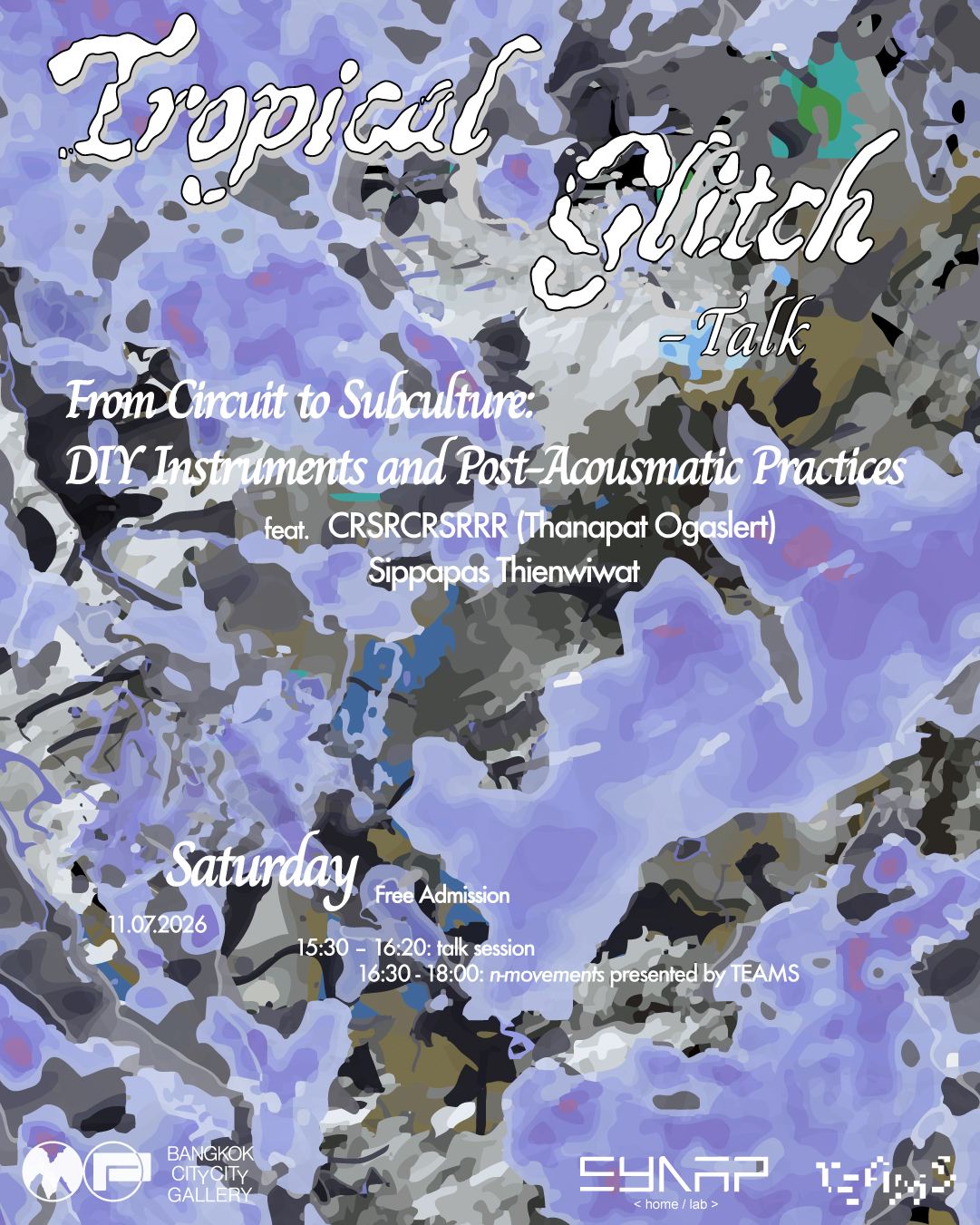
This tiny program is presented as part of the Tropical Glitch commissioned talk series for BANGKOK CITY CITY's MUSIC PROJECT, showcasing the livecoding work(s) of my teacher and brotherly figure Thanapat Ogaslert, which I will be doing sound diffusion for. The program is followed by a portrait concert of mine, presenting 2 works that have inspired me to write, and 2 of my recent works which I hold dear to my heart. The program closes with an improvisation on the no-input mixing boards of my teacher and me, cooperating as a TEAM.
– Sippapas Thienwiwatan act of overwhelming the stack.
Shale SeaShale Sea was written for the Thailand International Composition Festival 2014, hosted by Mahidol University.
for Rinka
The handy recorder is often regarded as an acousmatician's best friend for its portability and operability in many environments, and its capabilities of giving one an enhanced sonic worldview through monitoring in real-time. By putting headphones on, we hear things we normally cannot hear without the aid of technology, and in most cases, this becomes the starting point of the compositional process for most composers. By recording the sounds one hears in the moment, one can export the sonic memory of a location for further development in the studio. As a self-taught electroacoustic composer who spent the past three years writing exclusively with electronic sounds—and who wasted 4000 THB on a Zoom H4n Pro two years ago without having written a single work with it—I eventually needed to justify the purchase and prevent the device from collecting dust.
In "residues from a shared instant", the Handy Recorder is subjected to various forms of abuse—thrown around, dropped, forced through small spaces (including my BK collaborator Mark Chearavanont’s “Vernacular Objects” (2025)), built-in microphones dragged around and scratched, lent to Sonic Ventures workshop participants, and self-induced feedback—in order to gather textural and gestural materials that are familiar to the composer. From this point on, the recorded material passes through transformation processes that impart its memory into a new sonic context, achieved through spectral processing techniques, convolution, spatialization and collage. Through this process, the memory of recorded sound is not presented as a fixed imprint from a sequence of gestural sound making methods, rather as residue that persists even after recontextualization into a new timeline, even after countless stages of mutation. Thus, "residues from a shared instant" serves as a metaphor for my approach in working with a field recorder.
Commissioned for TagTEAMS 2026.
The French title (the same in Latin) - slopes, inclines, ascents - was suggested by the outlines of the broad stretches of the piece, which evoke spacious landscapes. Most of the music was created by transforming instrumental sounds. However, the only recognisable sound source is the Northumbrian pipes, whose drone is responsible for the slowly evolving harmonies out of which a haunting traditional melody appears. The piece was commissioned by the Groupe de Recherches Musicales, Paris, and was composed in their studios in 1974. The first performance took place in what is now called the Salle Olivier Messiaen, in the Maison de la Radio, Paris, on March 20th 1975.
for Gianni, warmly
“Time Slip” (2025-2026), as the title suggests, examines the recontextualization (time slip) of sound and visual material in sampling culture through an acousmatic collage. Constructed from a selected corpus of music videos of hit tracks by K-Pop girl group Red Velvet, the piece invites its audience to investigate the time slip phenomenon; catchy bubblegum pop lyrics slipped and displaced in time and space, interwoven with breakbeat fragments that slip into dark, deconstructed, destructive off-grid breakcore. Cutesy aegyo moments turn intense while words of love stretch to the depths of hell, reimagining the essence of “remixing” and “sampling” to its core.
The title “Time Slip” is derived from the 2015 Red Velvet song “Time Slip”, the 7th track of the “The Red” album.
The 2025-2026 version of “Time Slip” is reworked for Gianni Bencich-Grigore's February 2026 MiniBEAST curation (Jan-March 2026 season of miniBEAST). The original version was written for the IntAct Festival 2025 Performance 6 "Noise Untamed" at the Bangkok Kunsthalle, performed on the TEAMSmulch sound diffusion system.
Vulgar Display of Power is a metaphor for an act of noisy improvisation presented through the usage of two (2) no-input mixing boards. The no-input mixing board has long been popularized from the trend of reusing obsolete or 'crappy' gear, a result of rapid commercialization of entry-level professional audio equipment. The instrument is best known for usage in the community of 'noise music', which presents a colloquial image of a dirty, run-down spaces where performers go crazy on their instruments, a vulgar display of power. In an academic-like setting however, one could only wish they get to let it rip like that during their performance.
Vulgar Display of Power is our love letter to the no-input mixing board.
Vulgar Display of Power is our love letter to electronic music.
Vulgar Display of Power is our love letter to electronics.
“Thailand's new generation electroacoustic artist” (Time Out, Goethe Institut Thailand) Sippapas Thienwiwat (b. 2006) is a Bangkok-based composer, performer, digital artist, scholar, and curator whose work lies at the intersection of electroacoustic composition, live electronics improvisation, and digital arts practices. Working across fixed media and real-time performance, his work interrogates post-acousmaticism by treating technological systems as compositional material, shaping them through recontextualization, reconstruction, and spatialization while maintaining a keen historical awareness of electronic music practices and listening cultures. As SKYKYS, this approach extends into audiovisual livecoding performances that offer immersive experiences by combining algorithmic processes, multichannel sound environments, and audio-reactive visualizations.
Sippapas has presented and collaborated with institutions and festivals globally, notably with BEAST (including FEaST 2025, PGVIS2025: BEASTs of Wonderland, MiniBEAST, and TagTEAMS 2026), SEAMUS 2026 (UTSA), Sonorities Festival Belfast 2026 (via the 7th Improvising Futures Festival), SyReN SYNTHposium 2025, MUSLAB 2025: MANTRA, Hybrid Music Lab 2025 (Most Wanted: Music Berlin), University of North Texas CEMI (with Just the TRS! electronics sextet), EMuSE at Eastman School of Music (with OSSIA New Music, and BEAST), Current Plans Hong Kong (with Sonic Officer), SomaRumor: IV (Rádio Soma), BANGKOK CITYCITY MUSIC PROJECT (Commissioned Talk & Experimental Library Music), Thailand International Composition Festival 2025-2026, PGVIS and PGMF 2024-2025, IntAct Festival 2024-2025, MAXER-12 (a Triphens Ensemble production), and Rangsit International Symposium of Electroacoustic Music 2026. Past performances in Bangkok include a diverse list of spaces such as Bangkok Kunsthalle, One Bangkok, EmSphere, Goethe-Institut Thailand, Sala Saneha, Tentacles Workshop, JAM, Studio Lam, and SYNAP home/lab. His music can be seldomly heard accompanying Thai video art, including works by Yves Pokakunkanon, Kanyanat Sittisumpun, and Pich Rongmuang. He has received awards and grants from the Princess Galyani Vadhana Institute of Music and the Goethe Institut Thailand. His music has been described as “Brutally abstract” (Jiradej Setabundhu) and “The best noise I’ve heard so far at SEAMUS” (Elainie Lillios).
Sippapas serves as the President and Diffusion Artist-in-Residence of the Thai ElectroAcoustic Music Society (TEAMS), where he is mentored by Jiradej Setabundhu and Scott Wilson. As the Artistic Director, Curator, and Lead Technician for the inaugural TagTEAMS 2026 festival, he designed the TEAMSpace 26.2 loudspeaker orchestra along with the TEAMSmulch sound diffusion system for the performance of 40 concert works. These leadership roles run parallel to his BASc in Creative Arts and Technology at IMSE, KMITL, where he conducts practice-based research in electroacoustic music and computational arts under Matthias Jung. His academic work is further supplemented by private sonic arts and computational arts studies under Thanapat Ogaslert and previous music composition studies with Tyler Capp. Beyond his work with TEAMS, he is a member of the Cornea Cochlear Club collective and formerly served as the Technical Director of the Triphens Ensemble.
Thanapat Ogaslert (CRSRCRSRRR) is a Bangkok-raised sound artist who focuses on algorithmic mediums. His works span from installation art to live coding and live electronic performa nces, exploring sonic qualities of human interconnectivity. Thanapat’s works were included in major Art and design conventions such as Bangkok Design week and Bangkok art Biennale, Diage Festival, Intact Festival and International Computer Music Conference to name a few.
Thanapat has been one of the core members of Thai live coding community as a performer, organizer and educator. In addition, he is one of the founders of Synap [home/lab], a local sound-centric community located in Nang Loeng, Bangkok and has been constantly sharing and exchanging Bangkok sonic art culture with over 200 artists from abroad and local.
Currently, Thanapat conducts a class on creative programming and computer music and electronic music composition at Mahidol University Music College and International college.
Jiradej Setabundhu studied music with Bruce Gaston and worked as a guitarist and composer with Fong Nam Ensemble. He later continued his study with Donald Crockett, M. William Karlins, Marta Ptaszynska, Amnon Wolman, Michael Pisaro, and Stephen Syverud. His compositions include works for acoustic, electronic, and interactive multimedia that investigate the challenging relationship between human and technology.
Denis Smalley is a composer specialising in electroacoustic music. He was born in New Zealand in 1946, and completed music degrees at the University of Canterbury and at Victoria University of Wellington (MusB, and BMus honours). In 1971-2 he studied with Olivier Messiaen at the Paris Conservatoire, and took the course in electroacoustic composition with the Groupe de Recherches Musicales, completing the Diplôme de Musique Electroacoustique et de Recherche Musicale (Paris Conservatoire).
He then moved to England, living initially in York where he completed a doctorate in composition at the University of York. In 1976 he was appointed Lecturer in Music at the University of East Anglia, and as Senior Lecturer became Director of the Electroacoustic Music Studio. He was Professor of Music at City University, London from 1994 until he retired in 2009; he is now Professor Emeritus.
Professor Smalley's works have been widely acclaimed, winning a number of international awards including the Prix Ars Electronica in 1988. In 2008 he was awarded an honorary Doctor of Letters by the University of Huddersfield for his achievements in electroacoustic music. He has made original contributions to thinking about electroacoustic music, in particular his investigations into the listener's perception of electroacoustic music, and his development of the notion of spectromorphology (the shaping of sound spectra through time). His most recent writing has been concerned with the spatial image, and with spectromorphology in instrumental music. A book on his music and ideas was published by GRM/Ina in the Polychrome Portraits series - in English in 2010, and in French in 2011.
Three solo CDs of his music are available: 'Valley Flow, Piano Nets, Clarinet Threads, Wind Chimes, and Darkness After Time's Colours' on the Empreintes Digitales label (Canada); 'Névé' on Effects Input (Groupe de Musique Expérimentale de Marseille); and 'Base Metals, Empty Vessels, Tides and Pentes' on Empreintes Digitales.